His longest distance contact in
his Novice career when the photo was taken was his friend Billy on the other
side of town. Billy said Beaver was on
the track to winning a Worked All Neighborhoods Award. Beaver took that remark as an acknowledgement
of his communications prowess, even though Billy was laughing when he said it.

Mom snapped this picture to send to
her college alumni magazine. Not long
ago a fund raising hot shot suggested the school’s publication feature photos
of alumni children whom the parents thought were geniuses. The school now has enough photos to last until the
end of the decade.
Beaver is a smart kid, but not a
genius. In two evenings he read the ARRL’s
How to Become a Radio Amateur and The ARRL License Manual. He skimmed the Operating Manual.
Billy gave Beaver his 5 word per
minute code test. Billy signed the form
but calculated Beaver had attained only 4.8.
Since anyone aged 21 or over could administer the mail-in Novice written
test, Mom took on that task and gave Beaver an unprecedented A++. There is no such score in the regimented
bureaucracy of the FCC, of course, but Mom wrote a note across the top of the exam
form: “Beaver Beltlupe answered all 10 questions correctly with aplomb and
supporting research. One could only sit
back and marvel at his grasp of the concepts.”
She didn’t mention the help she provided on three of the questions. Nor
that Beaver took a lot of breaks and called Billy up three or four times. The FCC examiner may wonder about these
things when he opens the mail, but once
again he’ll remind himself that mail-in exams were not his idea.
When his uncle gave him the
LayFayette HE-10 receiver, which in truth was a kit-built KT-200, the two half
moon dials convinced Beaver he had the much vaunted Two-VFO rig. Never having heard of Bandspread, he
noticed VFO-B tuned only a very tiny part of the ham bands. When he couldn’t
find a socket to plug his mike or key into he realized it wasn’t a
transceiver. He was about to store it in
the attic when he judged he couldn’t listen to anything on his
transmitter. Finally, Mom suggested he
might listen on the receiver and talk on the transmitter. This knocked his socks off. He believed the
two of them had discovered a radically new concept, separate send and receive
boxes.
“Don’t tell Billy,” she
said. “You should get the full credit.”
Eventually Beaver got everything
running and re-read his Operating Manual.
He gave up on the loops and other radiators he had tried. He strung a dipole antenna between the attic
windows of the houses on either side of
his. The wire antenna loaded far
more easily than his house siding had, which turned out to be vinyl and not
aluminum. He bought a copy of The Radio
Amateur’s Handbook (before it was renamed The ARRL Handbook) and made an effort
to read and understand a few basic concepts.
He joined an on-air net and learned the rudiments of using his radios so
that other amateurs could understand him.
Beaver joined a ham radio club and subjected himself to a rash of
opinions on technical matters, politics, food choices, home invasion defenses,
sex and UFOs, but it didn't take a genius to discern which members actually
knew what they were talking about. Those
were the hams who said the least and drove the better automobiles.
When he brought his girlfriend
home one evening to show her his shack after he had upgraded to a General
license, she asked him, “How does it all
work?”

The question caught him off guard
and brought to mind the first time he had made a contact overseas. It was one
o’clock in the morning and the only light in the room came from the
radio dials. Outside his window a
blizzard of snow whipped around the street lights and traffic had come to a
standstill. And in his headphones was a
sound he’d never heard before. A slow
fist pounding out CQ, CQ, but with an unfamiliar hollow sound, the result of a
double or triple skip. So this was
DX. He had flipped the switches and
responded to the DL ham near Stuttgart.
“So?” said the girl, bringing him
back to the present. “How does it all
work?”
He briefly thought of all he had
learned about Ohm’s Law, resonant circuits, oscillators and the myriad of
circuits and devices that made his station work.
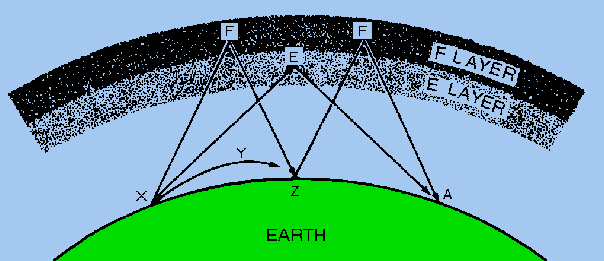
Remembering that snowy night and
the thrill of sending a signal to his dipole, where it was hurled up through
the stratosphere and along the paths of
space, depending upon the ionosphere to do its job, he smiled at her and gave
her the best overall answer he could summon.
“It’s magic,” he said.

Left to right: KnightKit T-50 transmitter, Lafayette HE-10 receiver (kit version was known as the KT-200,) with HeathKit QF-1 Q Multiplier on top. At a right angle sits the Globe Scout 65B cw and am phone transmitter. Also the famous (or infamous) Astatic D-104 microphone. Atop the Scout is an Allied Radio KnightKit Space Spanner ac/dc receiver, sporting original colors, battleship grey. Later versions featured a face panel of silver and dark grey.
David Griffin Copyright 2016
My complete list of stories is here:
http://www.windsweptpress.com/essays.htm
You are welcome to Friend me on Facebook at:
https://www.facebook.com/DaveBrotherJesse

The
Windswept Press
Murrells
Inlet, South Carolina


No comments:
Post a Comment